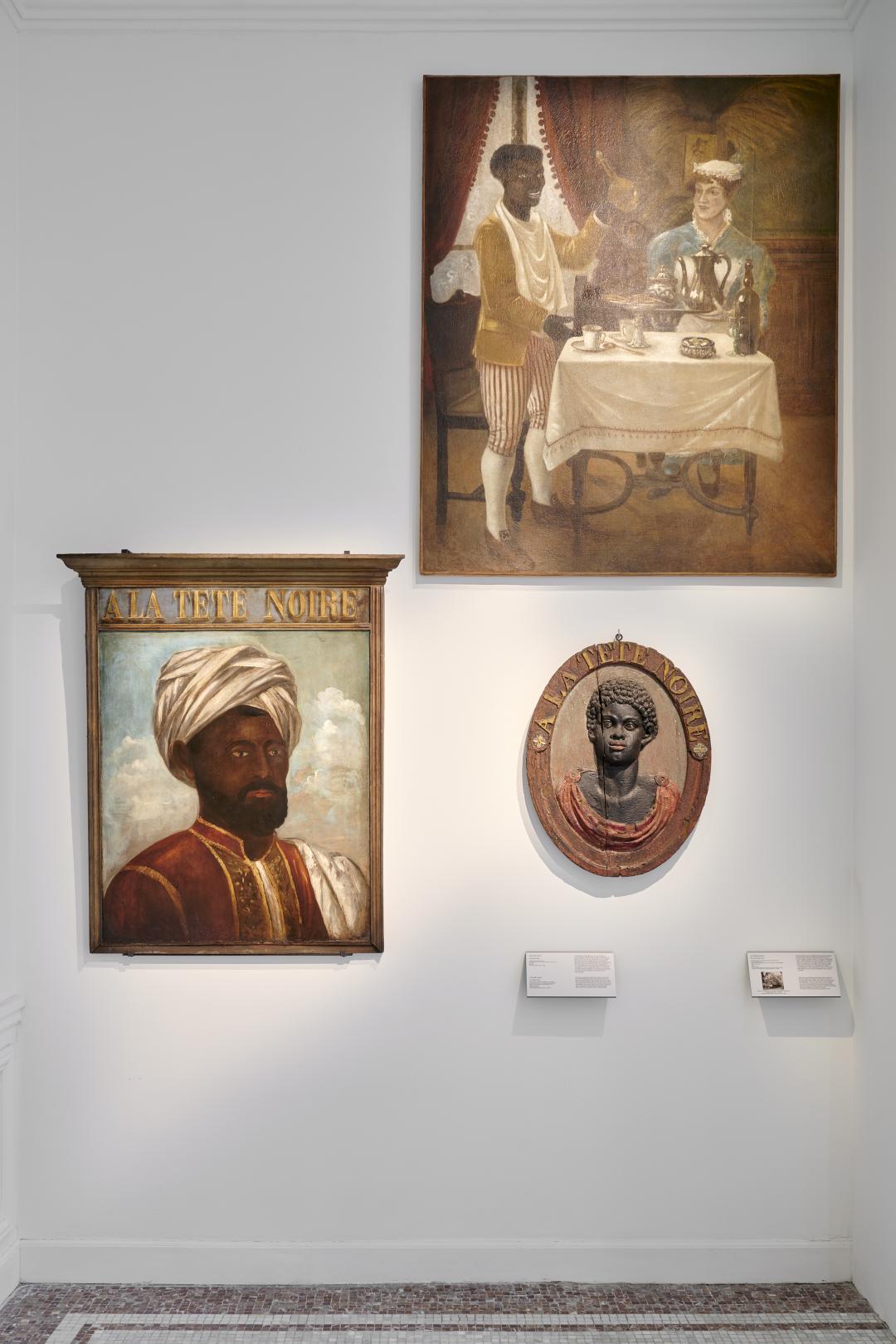
A sign used for advertising purposes
On the façade of 14 Rue Mouffetard, overlooking Place de la Contrescarpe, the sign established in 1897 was part of the fine food store’s advertising campaign: it consisted of painted panels and gables highlighting the prices charged and detailing the products sold, other panels evoking the wholesale and retail trade carried out in the store, and lastly two wide horizontal banners displaying the shop’s name (“Au Nègre Joyeux”) and flagship product (“Cafés”)
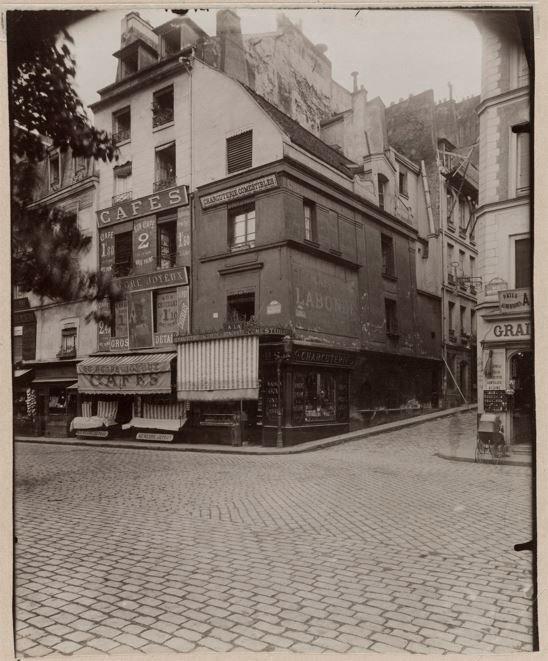
This photograph by Eugène Atget shows the sign with its early 20th-century layout. The top banner and several vertical panels indicate the types of products sold, in particular coffee, while the painting just above the front awning can be recognised in the centre.
The storefront was renewed in the 1960s. The name of the store changed, as did the types of products sold. As a result, the top “Cafés” (coffee) banner was removed a few years later, leaving only the central banner bearing the words “Au Nègre Joyeux” and the superimposed painting.
In 1986, concerned about the condition of the work, which had been altered by prolonged outdoor exposure, the co-owners of the building at 14 Rue Mouffetard in Paris contacted the Public Works Department of the City of Paris. These discussions led to a proposal for the co-owners to donate the sign to the City of Paris, which was accepted by the Paris City Council at its meeting of 24 October 1988. However, both elements remained in place.
Sign restoration work
The painting was damaged in 1999. The protective glass in front of the work was broken, causing damage to the work itself. In 2000, the painting was taken down and temporarily stored in a Conservation of Religious and Civil Works of Art (COARC) storeroom for restoration by restorer Madeleine Hanaire. Fitted with protective glass and repositioned on the façade in 2002, the sign was again damaged several times between 2002 and 2018. Impacts on the protective glass of the painting, spray paint and even attempts to remove it followed one another. In March 2018, the sign was removed for restoration as part of the City of Paris’ participatory budget, following a proposal by a group of residents from the 5th arrondissement.
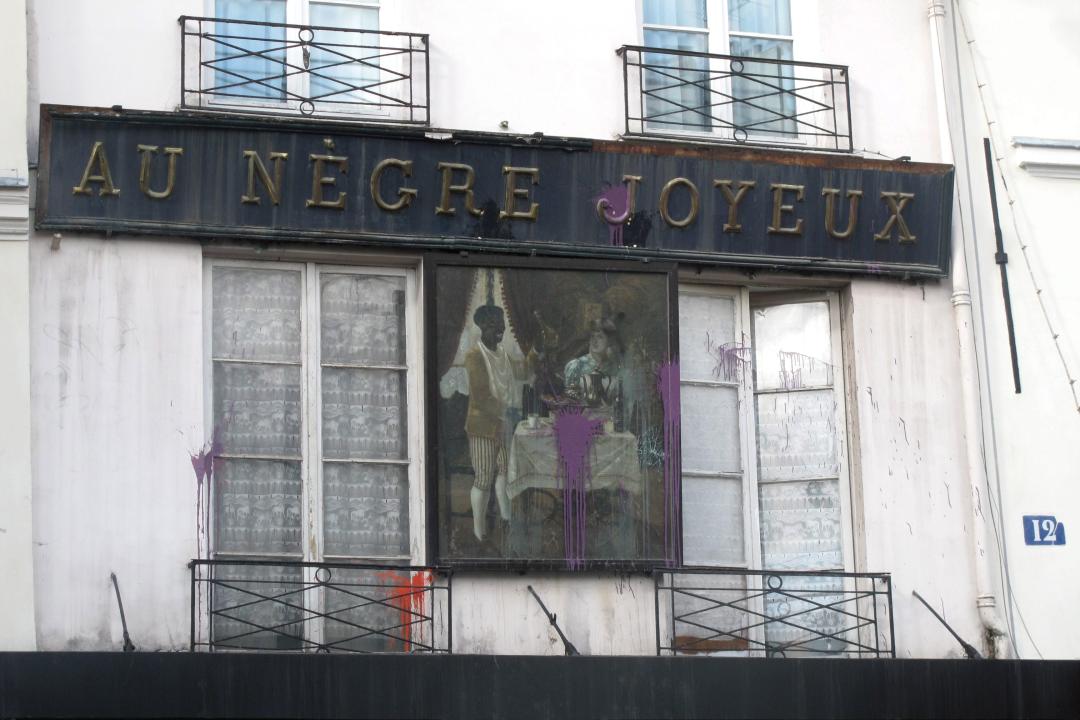
Monika Neuner was then commissioned to carry out new restoration work. On the painting, the restorer lightened and cleaned the paint layer, which was followed by spot retouching and the application of varnish. The advanced state of deterioration of the banner required several structural operations, including the repair of the three sheet steel panels supporting its structure, the re-installation of the original zinc letters after retouching, and lastly the repair of the wooden mouldings.
Display of the painting at the Carnavalet Museum - History of Paris
The painting has been on display at the Carnavalet Museum ever since it reopened in 2021. The banner, of imposing dimensions (5.54 meters long and 69.5 cm high), cannot be exhibited. Its presence is evoked by a photograph with commentary on the label of the work.
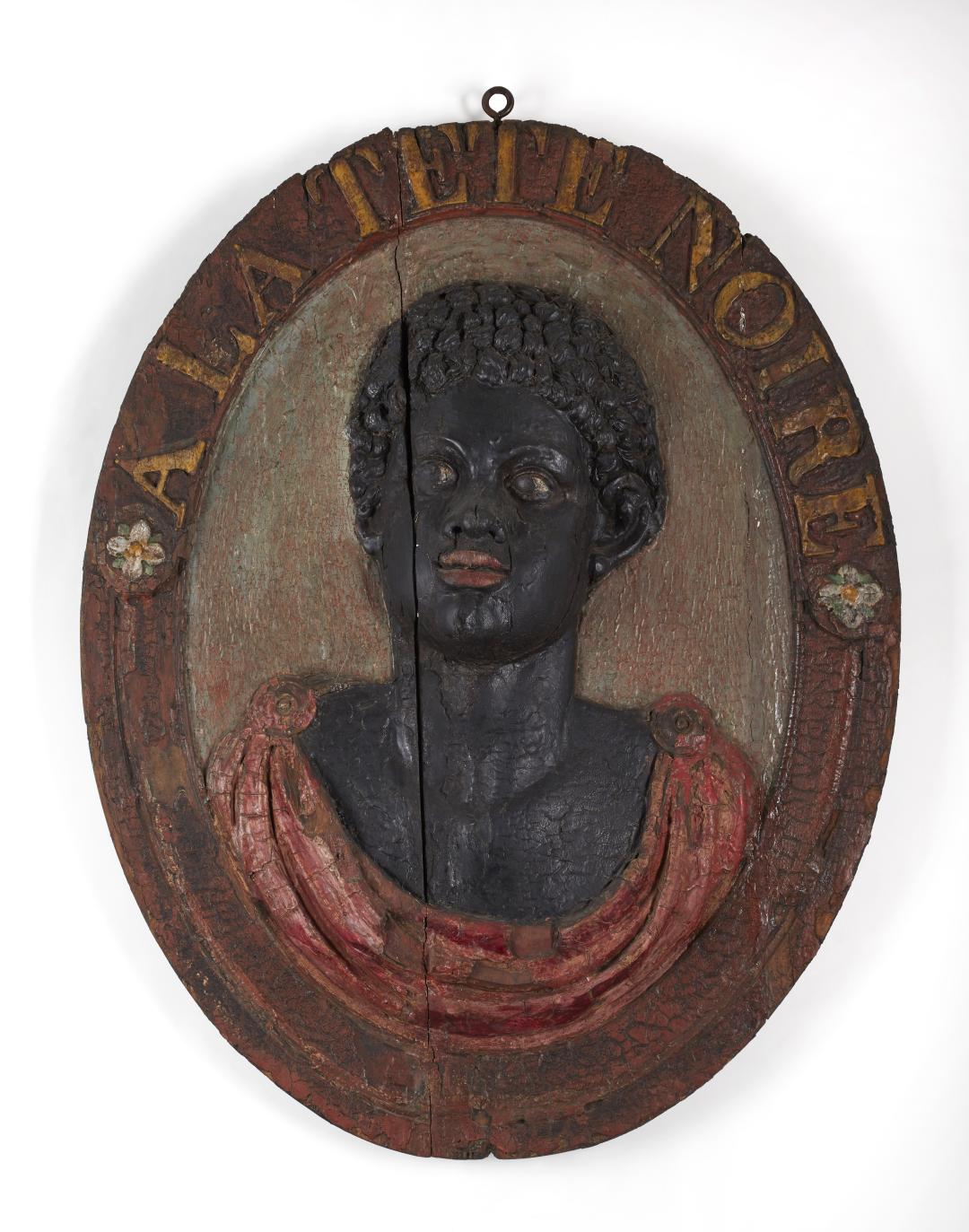
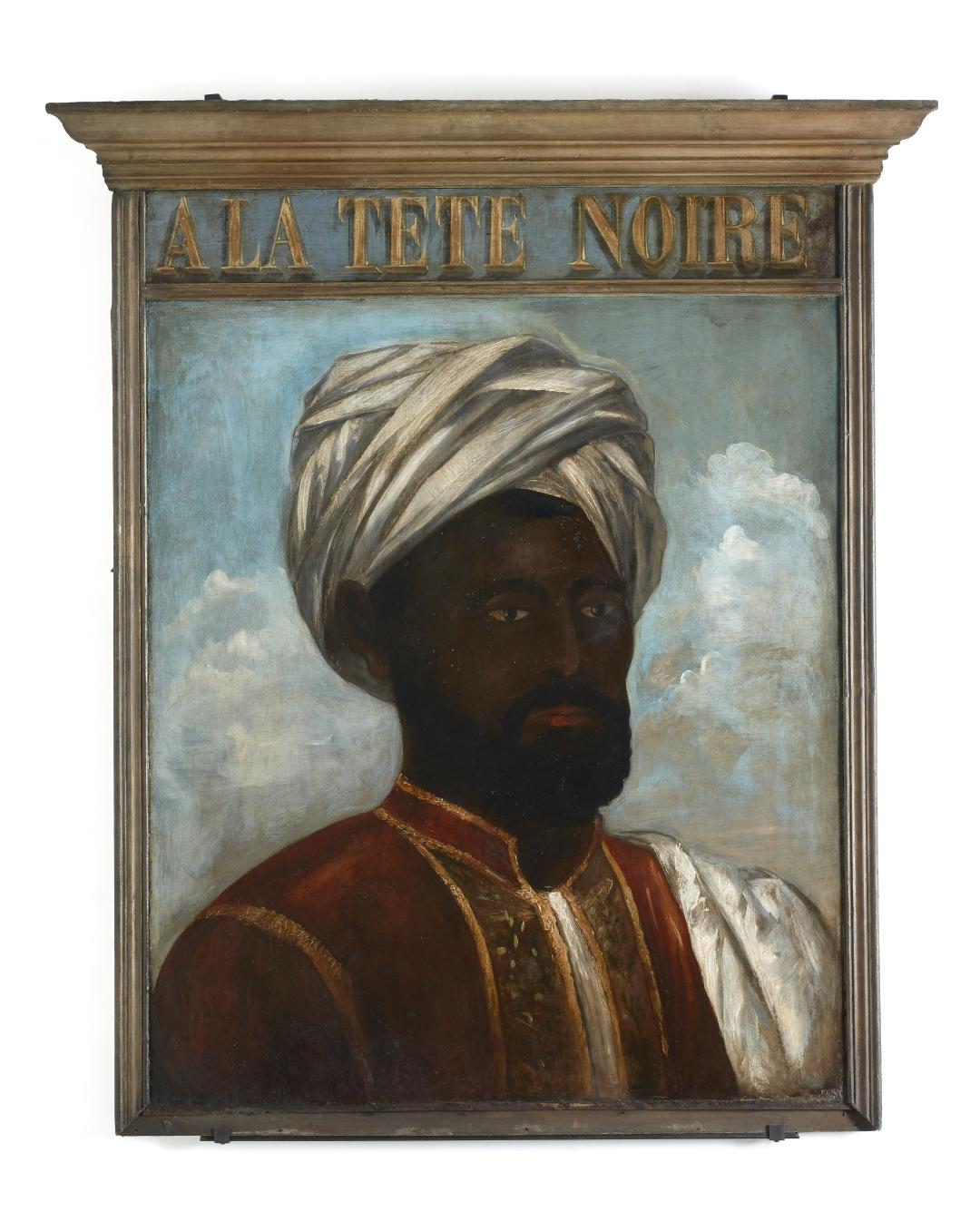
The sign is displayed next to two other signs in the museum’s collections that feature black figures, both bearing the title “À la tête noire”. Both were produced between the 18th and first half of the 19th centuries and predated the “Au Nègre Joyeux” sign. One was for the wine trade, the other for a furniture dealer.
The wine merchant’s sign refers to a tradition that dates back to medieval times, associating the black man with the world of the night. The image of the black man was frequently used in advertising from the 18th century onwards: racist clichés were used as selling points, associating the black man with enjoyment or laziness, in order to sell products such as wine, tobacco or various objects of comfort. The antique costume could also refer to Roman banquets, during which wine was served by slaves. As for the furniture dealer’s sign, it is in keeping with the tradition of exotic representations typical of the period in which it was produced.
The text of the label for the “Au Nègre Joyeux” sign was written by the scientific committee set up in 2018 (made up of historians Anne Lafont, Syliane Larcher, Pap Ndiaye, Emmanuelle Sibeud; Marie Aynié, Secretary General of the History Committee of the City of Paris; Valérie Guillaume, Marie-Laure Deschamps and Noémie Giard for the Carnavalet Museum - History of Paris):
“Often used to advertise food products imported from the colonies, the image of the black man and the word ‘nègre’ also refer to the history of slavery, which was abolished in France in 1848. Here, the man dressed in an 18th century costume is preparing to serve himself. This parodic representation, which reverses the common image of the black servant, bears witness to the racist clichés and stereotypes prevalent in the late 19th century”.